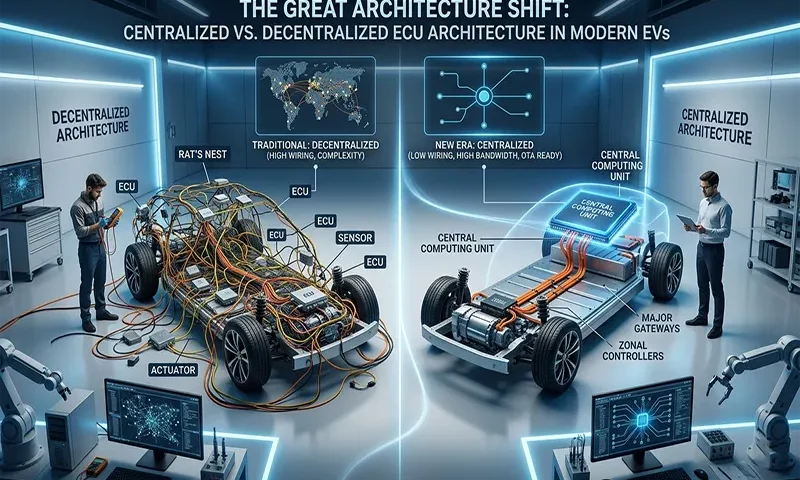
The Great Architecture Shift: Centralized vs. Decentralized ECU Architecture in Modern EVs

The automotive industry is currently navigating its most significant structural transformation since the invention of the assembly line. As we move through 2026, the focus has shifted from the mechanical “nuts and bolts” to the “bits and bytes.” At the heart of this revolution is a fundamental change in vehicle E/E (Electrical/Electronic) architecture. The transition from traditional, decentralized systems to centralized, zonal models is not just a technical preference; it is a survival requirement for the Software-Defined Vehicle (SDV) era.

1. The Complexity Crisis: The Wiring Harness Nightmare

For decades, the standard approach to vehicle electronics was “one function, one ECU.” If a manufacturer wanted to add power seats, they added a dedicated Electronic Control Unit (ECU) under the seat. By the early 2020s, premium vehicles reached a breaking point, carrying over 100 independent ECUs connected by miles of copper wiring.

This “Distributed Architecture” created a Wiring Harness Nightmare. … READ MORE ...

High-Performance Regenerative Braking Pads for Heavy Electric Vehicles

The transition to heavy-duty electric transport—encompassing Class 8 trucks, transit buses, and 8,000lb+ luxury SUVs—has introduced a fundamental “EV Brake Paradox.” In these vehicles, the electric motors perform the vast majority of deceleration via regenerative braking, converting kinetic energy back into the battery. Consequently, the physical friction brakes may sit dormant for miles. However, when those brakes are called upon—during a panic stop, a fully charged battery state (where “regen” is unavailable), or a system failure—they must arrest significantly more mass than their internal combustion engine (ICE) counterparts.

The kinetic energy equation,

$$E_k = \frac{1}{2}mv^2$$

, dictates that since a heavy EV often weighs 30–50% more than a comparable ICE vehicle, the friction hardware must be capable of absorbing and dissipating massive thermal spikes instantaneously, despite being “cold” just seconds prior.

1. Materials Science in 2026: Beyond Traditional Compounds

Historically, heavy-duty trucks relied on low-steel or semi-metallic pads for their … READ MORE ...

Managing Over-the-Air (OTA) ECU Software Updates for Fleet Vehicles

The automotive landscape has undergone a tectonic shift. In 2026, the vehicle is no longer a static piece of hardware but a Software-Defined Vehicle (SDV). For fleet operators, this evolution has transformed maintenance from a purely mechanical endeavor into a complex digital orchestration task. Transitioning from manual, dealership-based servicing to mass Over-the-Air (OTA) updates is no longer an “innovation”—it is a logistical necessity to reduce downtime, mitigate costly recalls, and ensure that thousands of mobile assets remain secure and compliant.

1. Regulatory Compliance & Engineering Standards

In the current regulatory environment, “pushing an update” is a high-stakes legal procedure. Fleet managers must operate within the framework of UNECE UN R156, which mandates a certified Software Update Management System (SUMS). This regulation ensures that every update is documented, traceable, and safe.

Furthermore, ISO 24089 provides the engineering roadmap for secure software update processes. Under these standards, updates are … READ MORE ...

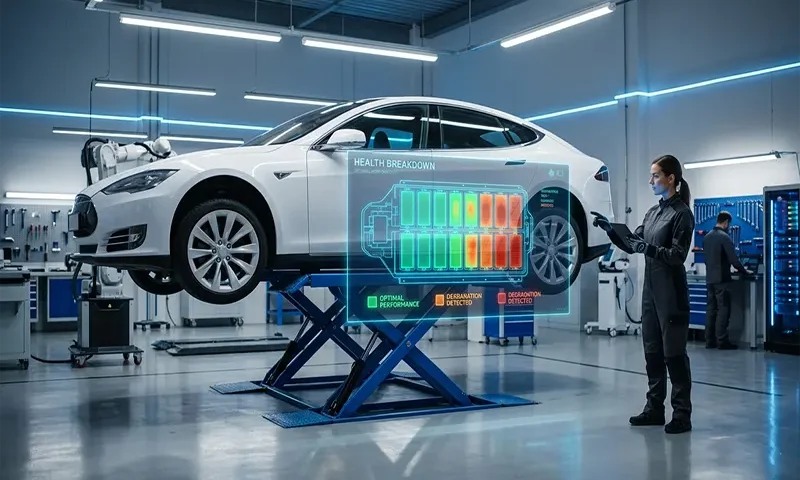
Diagnostic Tools for Checking Electric Car Battery Health and Degradation

The traction battery is the most critical and expensive component of an electric vehicle (EV), directly dictating the vehicle’s range, performance, and resale value. As the EV market matures in 2026, understanding the distinction between State of Charge (SoC)—the remaining energy for the current trip—and State of Health (SoH)—the permanent capacity remaining compared to the battery’s original state—has become essential for owners and technicians alike. Monitoring battery health is not just about range; it is a critical safety and economic imperative (Njoku et al., 2025).

The Science of Battery Degradation

Battery degradation is a complex physical and chemical process. It is primarily driven by mechanisms such as Solid Electrolyte Interphase (SEI) layer growth, lithium plating, and thermal stress (Anandavel et al., 2021). These processes lead to increased internal resistance, which causes voltage drops under load and reduces the total energy the battery can hold (Rao et … READ MORE ...

Supply Chain Challenges for EV Charging Port Components and Semiconductors

The rapid growth of the electric vehicle (EV) market has brought unprecedented demand for critical components such as charging port parts and semiconductors. These components are essential to ensuring that EVs operate efficiently and meet consumer expectations for range, charging speed, and safety. However, the industry is currently grappling with significant supply chain challenges that threaten to slow down production and delay EV adoption worldwide.

The Importance of Charging Port Components and Semiconductors in EVs

Charging port components connect EV batteries to external power sources, enabling convenient and fast recharging. These include connectors, cables, inlets, and control electronics designed for high power transfer and durability under frequent use.

Semiconductors, the backbone of modern automotive electronics, control everything from battery management systems and inverters to infotainment and advanced driver assistance systems (ADAS). Their role in power conversion and communication is crucial in optimizing EV performance and safety.

Key Supply Chain Challenges

READ MORE ...