
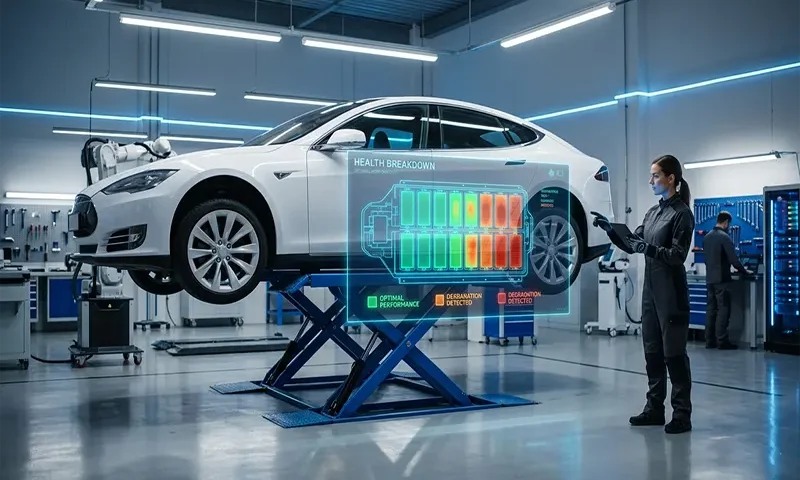
The traction battery is the most critical and expensive component of an electric vehicle (EV), directly dictating the vehicle’s range, performance, and resale value. As the EV market matures in 2026, understanding the distinction between State of Charge (SoC)—the remaining energy for the current trip—and State of Health (SoH)—the permanent capacity remaining compared to the battery’s original state—has become essential for owners and technicians alike. Monitoring battery health is not just about range; it is a critical safety and economic imperative (Njoku et al., 2025).
The Science of Battery Degradation
Battery degradation is a complex physical and chemical process. It is primarily driven by mechanisms such as Solid Electrolyte Interphase (SEI) layer growth, lithium plating, and thermal stress (Anandavel et al., 2021). These processes lead to increased internal resistance, which causes voltage drops under load and reduces the total energy the battery can hold (Rao et al., 2026). In severe cases, degradation can manifest as cell voltage imbalance, where certain modules fail significantly faster than others, potentially leading to thermal instability (MDPI, 2026).
Diagnostic Tools: From Consumers to Professionals
1. On-Board Diagnostic (OBD-II) & Consumer Apps
For everyday owners, the most accessible entry point is the OBD-II port. Using a compatible dongle (such as those based on the ELM327 chipset) and third-party software like LeafSpy or Recurrent, users can pull real-time data from the vehicle’s CAN bus. These tools allow for a non-invasive analysis of:
- Cell Voltage Spread: Identifying “weak” cells that drop voltage faster than others during acceleration.
- BMS-Reported SoH: The vehicle’s own internal estimate of its health.
- Temperature History: Identifying if the battery has been frequently exposed to health-sapping heat.
While useful, these tools primarily reflect what the car’s internal Battery Management System (BMS) thinks is happening. For a definitive assessment, more rigorous testing is required (MDPI, 2026).
2. Professional Workshop Diagnostics
Dealerships and specialized EV workshops use advanced hardware to go beyond software estimates. Common methods include:
- Internal Resistance Measurement: Using pulse testing to record how the battery’s voltage responds to short current bursts (Rao et al., 2026).
- Electrochemical Impedance Spectroscopy (EIS): A gold-standard laboratory technique now migrating to high-end field tools that uses alternating electrical signals to map the “impedance fingerprint” of a battery (Rao et al., 2026).
- Controlled Capacity Tests: Discharging the battery from 100% to 0% under a steady, known load to measure exactly how many Ampere-hours (Ah) remain (MDPI, 2026).
3. The Rise of “Digital Twins” and Cloud AI
In 2026, the cutting edge of diagnostics lies in Digital Twin technology. By syncing real-time sensor data from the vehicle to a cloud-based virtual model, manufacturers can create a “living” simulation of the battery (Njoku et al., 2025). This allows for:
- Predictive Maintenance: Predicting a cell failure weeks before it happens.
- Multi-Source Data Fusion: Using machine learning to combine temperature, charging habits, and discharge cycles into a highly accurate health indicator (Njoku et al., 2025).
Independent Certification and the Used Market
As EVs change hands, independent battery health reports (e.g., from companies like Aviloo) are becoming as common as a CARFAX report. These certifications provide an objective SoH percentage that is independent of the manufacturer’s own BMS, which can sometimes be “optimistic” to avoid warranty claims.
Best Practices for Battery Longevity
Data-driven insights from diagnostic tools suggest three golden rules for preserving health:
- The 20-80 Rule: Avoid keeping the battery at 0% or 100% for long periods; the “sweet spot” for chemical stability is the middle range.
- Thermal Management: Use “pre-conditioning” features in extreme weather to ensure the battery is at an optimal temperature before charging.
- Minimize DC Fast Charging: While convenient, frequent high-current charging increases internal heat and accelerates degradation compared to slower AC charging.
The future of electric mobility depends on battery transparency. With the advancement of AI-driven Digital Twins and more sophisticated workshop tools like EIS, the “black box” of the EV battery is finally being opened. These diagnostic advancements ensure that as vehicles age, they remain safe, efficient, and valuable.

