
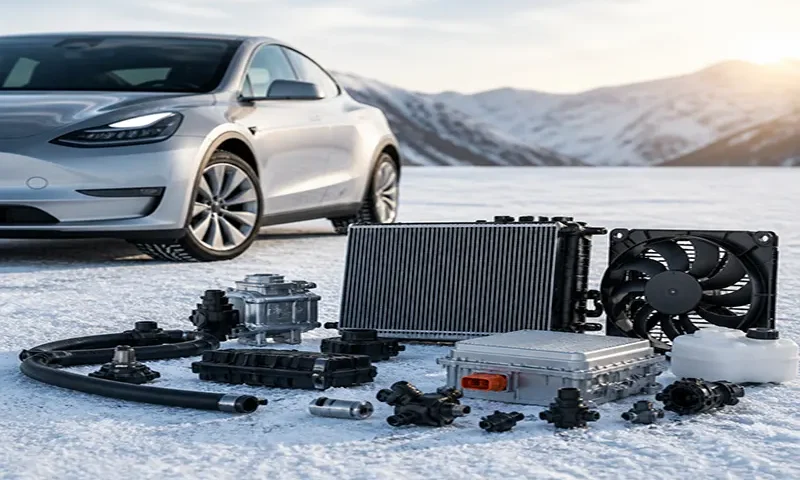
As the electric vehicle (EV) market matures in 2026, the industry has shifted its focus from simple range extension to resilient engineering optimization. For drivers in cold climates, the Thermal Management System (TMS) is no longer a hidden background process; it is the single most critical factor for winter range and battery longevity.
The following guide details the specific replacement parts, engineering standards, and maintenance protocols required for EV thermal systems as they navigate the sub-zero challenges of 2026.
1. The Thermal Challenge: The “Goldilocks Zone”
Batteries are essentially chemical engines that perform best in a “Goldilocks Zone” of 15°C to 25°C. When ambient temperatures drop below freezing, internal resistance increases, and the chemistry becomes sluggish. In legacy EVs, this was countered by resistive heating—essentially a massive toaster element that drained up to 7kW of power.
In 2026, we have moved toward integrated heat pump loops. Instead of just creating heat, these systems “scavenge” waste thermal energy from the eAxle, motor, and power electronics. This shift has changed the replacement parts market from simple heater cores to complex mechatronic modules.
2. Core Replacement Components for Cold Climates
The Heat Pump Unit & Electric Compressor
The heart of the 2026 TMS is the heat pump. Unlike traditional AC compressors, these units are designed for bidirectional flow and high-pressure operation in extreme cold.
- Wear Item: The Electric Refrigerant Compressor. In cold climates, these units run at high RPMs to compress refrigerant for cabin and battery warmth.
- Engineering Note: Modern replacements, such as Bosch’s Flexible Thermal Units, are now modular, integrating the pump, control unit, and heat exchanger into a single “plug-and-play” module to simplify repairs.
5-Way Refrigerant & Coolant Valves
The “brain” of heat distribution. These multi-way valves replace dozens of individual solenoid valves found in older EVs. They are responsible for routing heat to the battery during a pre-conditioning cycle or to the cabin during a morning commute.
- Failure Mode: Internal seal degradation due to extreme temperature cycling (swelling and contracting), leading to “thermal cross-talk” where the battery is unintentionally cooled during a heating request.
High-Voltage PTC (Positive Temperature Coefficient) Heaters
Even with advanced heat pumps, most 2026 EVs retain a PTC heater as a “booster” for temperatures below -10°C, where heat pump efficiency (COP) drops.
- Replacement Context: These ceramic heaters are self-regulating, but they can suffer from ceramic fatigue or high-voltage arc-over if the coolant quality has degraded.
3. Battery Dynamics: Prevention of Lithium Plating
One of the most vital replacement categories involves the heaters located inside or under the battery pack. Charging a frozen battery can cause permanent damage through Lithium Plating.
- Thin-Film Flexible Heaters: These silicone or polyimide heaters are applied directly to cell modules. In 2026, many technicians are replacing these during mid-life pack refurbishments to ensure the battery can still accept ultra-fast charging (up to 600kW) in winter.
- Sensors: We are seeing a move away from simple thermistors to AI-integrated sensors that monitor the “Core-to-Surface” temperature gradient. If a sensor fails, the Battery Management System (BMS) will aggressively throttle charging speeds to 10–20kW as a safety precaution.
4. Fluid Maintenance: The 2026 Standards
| Fluid Type | Purpose | 2026 Standard |
| Low-Conductivity Coolant | Indirect battery cooling/heating | GB 29743.2-2025 |
| Dielectric Fluids | Immersion cooling for high-performance packs | Ultra-low viscosity for sub-zero flow |
| Heat Pump Refrigerant | Thermal energy transfer | R1234yf or CO2 (R744) |
In 2026, the use of standard “automotive antifreeze” is a liability. New regulations require ultra-low conductivity coolants (such as GLYSANTIN® ELECTRIFIED®) to prevent hydrogen generation and fire risks in the event of a micro-leak within the high-voltage battery casing.
5. Diagnostic Checklist for Cold Weather Failures
If an EV’s winter range drops by more than 40%, check these thermal components in order:
- GPS-Linked Pre-conditioning Check: Is the vehicle software failing to trigger the heater because it doesn’t “know” it’s approaching a charger?
- Inverter Coolant Pump: If this fails, waste heat from the motor cannot be “scavenged,” forcing the car to use 100% resistive heating and destroying range.
- Thermal Drawdown Test: Use a diagnostic tool to check the Coefficient of Performance (COP) of the heat pump. A COP below 1.5 at 0°C usually indicates a refrigerant leak or a failing compressor.
The Future of Proactive Repair
With the introduction of Digital Battery Passports in 2026, the health of your thermal management system is now a permanent part of the vehicle’s record. A faulty valve or a degraded heater doesn’t just make the cabin cold; it lowers the vehicle’s State of Health (SoH) and resale value. By prioritizing high-quality replacement parts like multi-way valves and low-conductivity coolants, owners can ensure their EVs remain resilient, efficient, and valuable through many winters to come.

