

Navigating India’s Renewable Power Boom With Informed Caution
India’s push toward clean electricity has become one of the most closely watched themes in the equity market. Many investors exploring Green Energy Stocks are motivated by the long runway of policy support and rising power demand. Others focus on a single large name, and they often check the Adani green share price to gauge how the market values a company building solar, wind and hybrid capacity at scale. Enthusiasm is understandable, but a sector this capital-hungry rewards those who understand the economics before committing funds.
How Renewable Companies Earn Money
A renewable power producer makes money by selling electricity to a distribution company, government agency, industry or even another producer, where the contracts are long-dated, twenty-five-year deals with tariffs set at the point of signing. This is advantageous to the company, as it provides visibility on revenues for the life of the plant if it achieves its design parameters.… READ MORE ...


How to Setup Business in Dubai Free Zone for Consulting?
Key Takeaways:
- Dubai Free Zones offer 100% foreign ownership, full profit repatriation, and zero corporate/personal income taxes for consulting businesses.
- Selecting the appropriate free zone involves evaluating costs, permitted activities, and location to align with your specific consulting niche.
- The setup process includes defining your business activity, reserving a trade name, securing initial approvals, providing documentation, and obtaining your license.
- Careful preparation of documents, including shareholder passports and business plans, is crucial for a smooth application.
- Post-licensing, focus on visa processing, bank account activation, and ongoing compliance to ensure operational success.
Dubai has established itself as a global business hub, attracting professionals and companies worldwide. For consultants aiming to establish a strong presence in the Middle East, setting up a business in one of Dubai’s numerous Free Zones offers an attractive pathway. These zones provide a unique ecosystem designed to foster growth, offering significant advantages for services like management, HR, … READ MORE ...
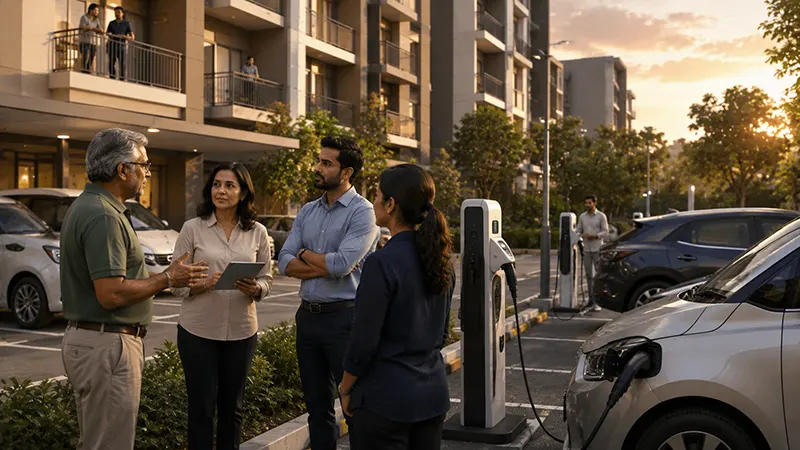
How Many EV Chargers Does Your Apartment Really Need? A Practical Guide for RWAs and Residents
Every apartment community will eventually face the same question: How many EV chargers should we install?
The answer isn’t as simple as installing one EV charger for apartment parking or adding chargers for every parking slot. Effective EV charging for buildings depends on current EV ownership, future demand, available electrical capacity, and smart planning. Getting this balance right can help apartment communities avoid unnecessary costs while preparing for the future.
Start with Demand, Not Parking Spaces
A common misconception is that every parking bay needs a dedicated charger from day one.
In reality, EV adoption happens gradually. An apartment with 200 parking spaces may currently have only 10–15 EVs. Installing 200 chargers upfront would be expensive, underutilized, and difficult to justify.
Instead, communities should ask:
- How many EVs currently live in the building?
- How many residents plan to buy an EV in the next three to five years?
- How long
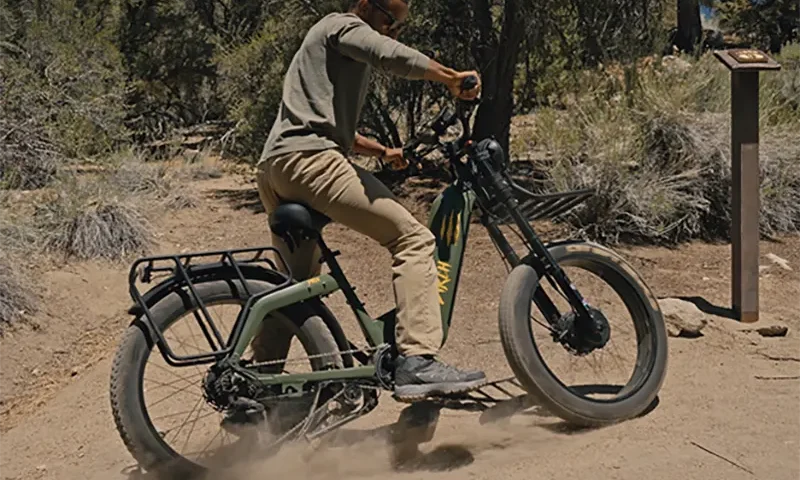
I Tried an All-Wheel-Drive E-Bike for Hunting—Here Is the Honest Truth
For the last few seasons, the debate in my hunting circle has been all about mid-drive vs. hub-drive electric bikes. I’ve always been a mid-drive purist. In the mountains, leveraging the bike’s actual gears to climb steep ridges just makes mechanical sense.
But this season, I kept hearing about the raw pulling power of All-Wheel Drive (AWD) hunting e-bikes like the Rambo Megatron and the Birch Grolar. Intrigued by the idea of dual-motor traction, I finally took an AWD beast deep into the backcountry to see if it was a legitimate tactical upgrade or just marketing hype.
After a week of navigating thick mud, hauling gear, and testing its limits, here is my honest field report.
1. First Impressions: A Truck on Two Wheels
The first thing you notice about an AWD hunting e-bike is the weight. Sporting dual motors (usually a 750W or 1000W hub motor in both … READ MORE ...
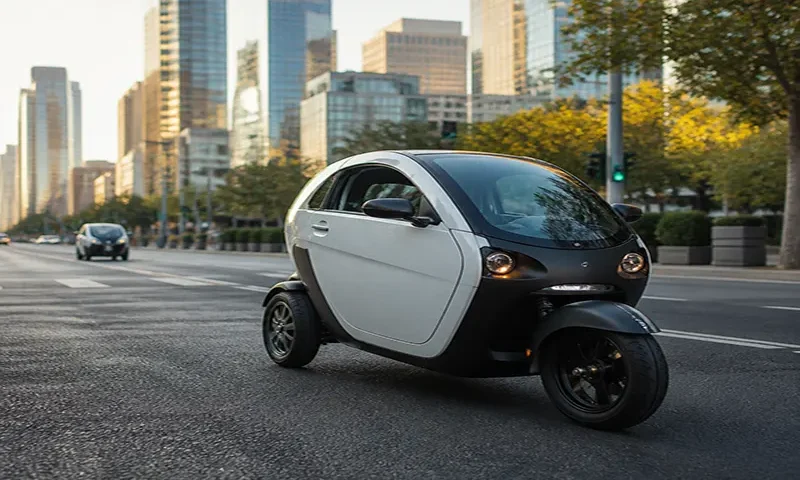
The Three-Wheel Revolution: Ultra-Compact Electric Cars for Eco-Friendly City Commuting in 2026
In the dense urban centers of 2026, the traditional four-door sedan has become a liability. As metropolitan areas worldwide enforce stricter congestion zones and “15-minute city” initiatives, a new category of vehicle has reclaimed the asphalt: the ultra-compact three-wheel electric car.
These vehicles, often classified as “autocycles,” address the fundamental geometry of urban congestion. With 76% of commuters still traveling alone in 2,000kg vehicles, the math of the modern city simply didn’t add up. Enter the 2026 three-wheeler—a marriage of motorcycle agility and automotive safety.
1. The Engineering of Efficiency: Less is More
The brilliance of the 2026 ultra-compact lies in its extreme weight-to-range ratio. By shedding the fourth wheel and the massive structural requirements of a 2-ton SUV, these vehicles redefine what a kilowatt-hour can achieve.
- Curb-Weight Optimization: Most 2026 models weigh between 500kg and 800kg. This allows for a 100+ mile range using a modest 10-20kWh battery,