
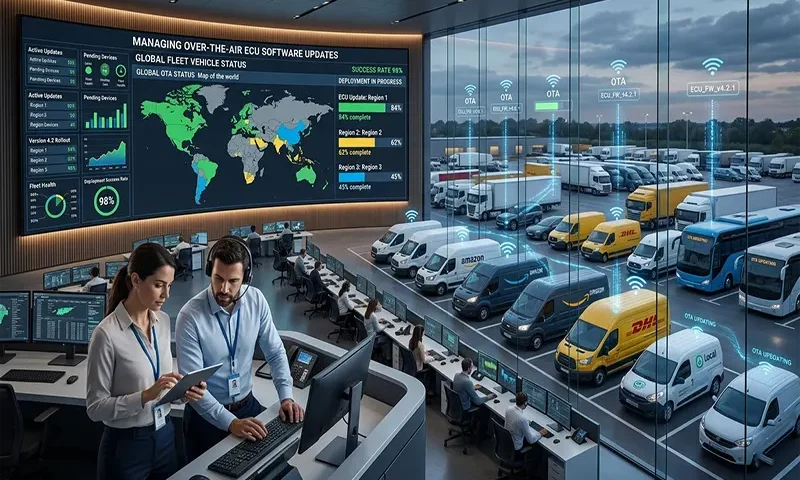
The automotive landscape has undergone a tectonic shift. In 2026, the vehicle is no longer a static piece of hardware but a Software-Defined Vehicle (SDV). For fleet operators, this evolution has transformed maintenance from a purely mechanical endeavor into a complex digital orchestration task. Transitioning from manual, dealership-based servicing to mass Over-the-Air (OTA) updates is no longer an “innovation”—it is a logistical necessity to reduce downtime, mitigate costly recalls, and ensure that thousands of mobile assets remain secure and compliant.
1. Regulatory Compliance & Engineering Standards
In the current regulatory environment, “pushing an update” is a high-stakes legal procedure. Fleet managers must operate within the framework of UNECE UN R156, which mandates a certified Software Update Management System (SUMS). This regulation ensures that every update is documented, traceable, and safe.
Furthermore, ISO 24089 provides the engineering roadmap for secure software update processes. Under these standards, updates are classified by their ASIL (Automotive Safety Integrity Level). An update to an infotainment system (ASIL A or B) follows a different safety path than an update to the braking or steering Electronic Control Units (ASIL D), which requires rigorous validation and specific safety guardrails to prevent mid-update failures from “bricking” a vehicle on the road.
2. The Orchestration Architecture
Managing a fleet of 5,000 vehicles is fundamentally different from updating a single smartphone. It requires a robust, multi-layered architecture:
- The Backend (SUMS): The central repository handles version control. Since a fleet often contains different vehicle makes, models, and “hardware-software” configurations, the SUMS must ensure that Package A is only sent to Vehicle Configuration B.
- The Campaign Pipeline: Updates are deployed in “rings.”
- Ring 1 (Canary): A tiny subset of vehicles to detect unforeseen bugs.
- Ring 2 (Pilot): A specific region or sub-fleet.
- Ring 3 (General Release): Full fleet deployment.
- Delta Compression: To manage cellular data costs—a massive overhead for global fleets—modern systems use Delta Flashing. Instead of sending a 2GB firmware file, the system sends only the “diff” (the changed code), which might be only 50MB, significantly reducing bandwidth and transmission time.
3. Operational Best Practices for Fleet Managers
Success in OTA management is determined by the Pre-Condition Check. Updates should never be forced; they must be “orchestrated” around the fleet’s operational heartbeat.
- Context-Aware Triggers: The vehicle’s gateway must confirm specific safety states before initiating a flash. Common “Safe-to-Update” parameters include:
- Transmission: Gear in ‘Park’.
- Ignition: ‘Off’ (or in a specialized update mode).
- Power: Battery State of Charge (SoC) > 50% or connected to a charger.
- Geo-fencing and Scheduling: Fleet managers should schedule updates during low-activity periods (e.g., 2:00 AM) and use geo-fencing to ensure updates only trigger when a vehicle is at a depot with high-speed Wi-Fi, rather than on a remote highway with spotty 5G coverage.
- The Fail-Safe Rollback: Every update must have an automated rollback strategy. If the ECU detects a checksum error or an incomplete flash, it must be capable of autonomously reverting to the previous “Last Known Good” state to ensure the vehicle is not sidelined.
4. Cybersecurity & The Chain of Trust
OTA updates are a primary attack vector for malicious actors. To protect the fleet, the industry has adopted the Uptane framework, which is specifically designed for automotive security.
- The Chain of Trust: Every piece of code is digitally signed. The vehicle’s Hardware Security Module (HSM) verifies these signatures before allowing the ECU to be flashed.
- Separation of Duties: By isolating the “Update Image” from the “Update Command,” attackers cannot easily spoof a malicious update even if they gain access to a single server.
5. Challenges of Autonomous & AI-Defined Fleets
As we move toward 2026 and beyond, the rise of Autonomous Business Operations adds a layer of complexity: Continuous Certification. When a fleet uses AI-driven driving agents that “learn” or adapt, fleet managers must ensure that a software update doesn’t inadvertently invalidate the vehicle’s original safety certification. This requires a “Digital Twin” approach, where updates are simulated in a virtual environment before being deployed to the physical fleet.
Toward Zero-Touch Maintenance
The shift to managed OTA updates represents the end of the “service center” era for software-related issues. By implementing a standardized, compliant, and security-first OTA strategy, fleet operators can transform their assets into dynamic tools that improve over time. The goal is Zero-Touch Maintenance: a fleet that is always at peak performance, always secure, and always ready for the next mile, all without a single technician ever opening a door.

