
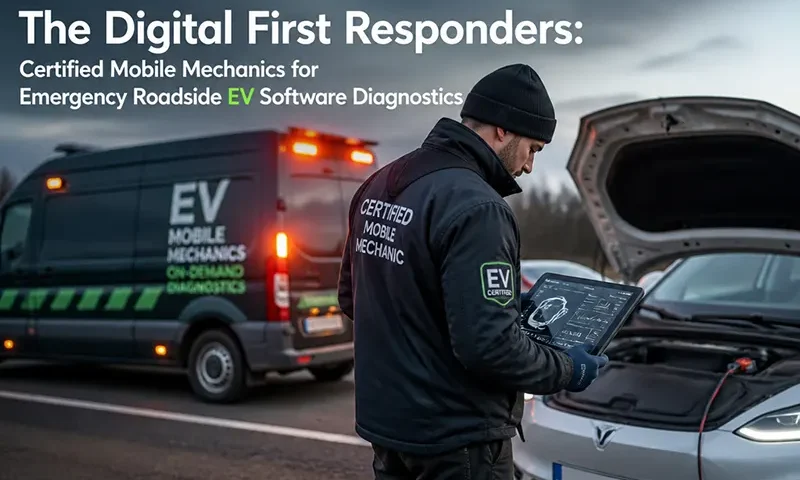
In the automotive landscape of 2026, the “breakdown” has been redefined. While internal combustion engines traditionally succumbed to mechanical failures—broken belts, fuel pump clogs, or radiator leaks—the modern Electric Vehicle (EV) is a sophisticated “computer on wheels.” Consequently, the most common reason for an EV becoming immobilized today isn’t a mechanical snap, but a software “handshake” failure or a logic loop in the Battery Management System (BMS).
The emergence of Certified Mobile EV Software Technicians marks a pivotal shift in roadside assistance. We are moving away from the era of the flatbed tow truck and toward the era of the “Digital First Responder”—highly skilled technicians who arrive in mobile cyber-labs to perform curbside triage on complex software-defined vehicles.
1. The Software-Defined Breakdown
For a 2026 EV, immobilization often occurs when the vehicle’s “brain” detects a conflict it cannot resolve. This might manifest as a vehicle that refuses to shift into gear after a failed Over-the-Air (OTA) update, or a “Critical Battery Fault” that is actually a sensor calibration error rather than a physical cell failure.
In these scenarios, towing the vehicle is often counterproductive. Many modern EVs are difficult to tow without specialized “skates” because their parking pawls are electronically locked. A digital intervention at the curb is not only faster but safer for the vehicle’s high-voltage architecture.
2. The Certification Standard: Beyond ASE
A “Digital First Responder” is not a standard mechanic. In 2026, the gold standard for these professionals involves a multi-layered certification stack:
- ASE L3 Specialist: The baseline certification for Light Duty Hybrid/Electric Vehicle Specialists, ensuring a deep understanding of powertrain interactions.
- High-Voltage (HV) Level 3 Safety: Essential for mobile environments. Technicians must be certified to perform “Safe-to-Work” procedures, including the use of insulated tools and Class 0 high-voltage gloves, even on a rainy roadside.
- OEM-Specific Credentials: Because software architectures vary wildly between brands (e.g., Tesla’s centralized vs. legacy zonal architectures), technicians must hold specific credentials to access proprietary diagnostic portals like Ford Pro Service or Tesla Toolbox 3.
3. Emergency Diagnostic Toolkit: The Mobile Lab
To resolve a software lockout in the field, the mobile technician utilizes a toolkit that looks more like an IT professional’s rig than a traditional toolbox.
- Dealer-Level Scan Tools: Devices like the Autel MaxiSYS Ultra EV allow technicians to perform “Active Tests” on the vehicle. They can manually command the battery contactors to close or force a recalibration of the electronic parking brake.
- 5G Remote Expert Link: If a technician encounters a unique “edge case” bug, they can initiate a 10Gbps 5G link to a central engineering hub. A remote senior engineer can then “tunnel” into the vehicle’s CAN-bus to pull raw data logs.
- 12V/16V Recovery Systems: Many EV “deaths” are caused by the failure of the low-voltage battery, which powers the computers that wake up the high-voltage battery. Mobile techs use specialized power supplies to “wake up” the VCU (Vehicle Control Unit) without triggering a surge.
4. Common 2026 Roadside Software Failures
| Failure Type | Description | Mobile Intervention |
| Charger Handshake Error | Failure in ISO 15118 protocol; car won’t release the plug or start charging. | Protocol reset via VCU software override. |
| BMS Logic Loop | The battery thinks a sensor is out of range and enters “Safe Mode.” | Clearing of non-critical DTCs (Diagnostic Trouble Codes) and sensor re-zeroing. |
| OTA Update Brick | A firmware download was interrupted, leaving the vehicle unresponsive. | Manual firmware injection via the vehicle’s diagnostic gateway. |
| Keyless Entry Timeout | The phone-as-a-key (PaaK) system de-syncs from the vehicle’s security module. | Re-pairing of digital certificates and Bluetooth module reset. |
5. Logistics & The “Repair-on-Site” Economy
For 2026 fleet operators—managing thousands of electric delivery vans or ride-share vehicles—every hour of downtime is a direct hit to the bottom line. The cost of a flatbed tow to a dealership, followed by a three-day wait for a service bay, can exceed $1,500 in lost revenue.
In contrast, a Certified Mobile Mechanic can often resolve a software-based immobilization in under 45 minutes at the curb. This “Repair-on-Site” model is becoming the backbone of EV logistics, supported by apps that allow drivers to share vehicle logs with the technician before they even arrive on the scene.
6. The Future of Roadside Service
As we look toward the late 2020s, the image of a mechanic covered in oil is being replaced by a technician staring at a high-resolution data stream. Certified Mobile EV Software Technicians are the unsung heroes of the electric transition, providing the digital safety net that allows consumers and businesses to trust their “computers on wheels.” In 2026, when your car stops moving, the most important tool in the kit isn’t a wrench—it’s the right line of code.
Comparison: Traditional vs. Digital Roadside Assistance
| Feature | Traditional RSA | Digital EV RSA (2026) |
| Primary Tool | Tow Hook / Fuel Can | Diagnostic Tablet / 5G Link |
| Technician Goal | Transport to Shop | Resolve at Curbside |
| Key Skillset | Mechanical / Towing | Software Triage / HV Safety |
| Equipment | Flatbed Truck | Mobile Cyber-Lab Van |
| Success Metric | Time to Hook | Success of Module Reset |

