
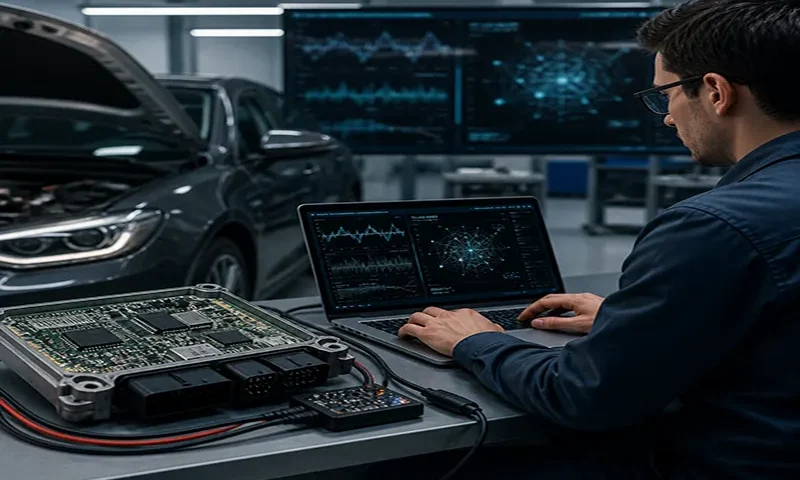
In the automotive engineering landscape of 2026, the traditional “Check Engine Light” has become an artifact of the past. As vehicles transition into high-performance Software-Defined Vehicles (SDVs), the industry has moved beyond reactive Diagnostic Trouble Codes (DTCs) toward agentic, real-time Prognostics and Health Management (PHM).
Today, the goal is no longer to identify that a module has failed, but to detect the “micro-symptoms” of hardware degradation weeks before a malfunction occurs. By leveraging Agentic AI at the edge, modern EVs can now sense their own digital pulse, identifying imminent hardware failures in Electronic Control Units (ECUs) that were previously invisible to rule-based systems.
1. The Physics of ECU Failure: Identifying “Silent Symptoms”
Hardware failure in an ECU rarely happens instantaneously. It is usually the result of long-term stressors—thermal cycling, vibration, or electrical overstress—that leave measurable traces in the vehicle’s telemetry. AI models in 2026 are trained to identify these specific physical symptoms:
- Thermal Drift and Power Stages: Before a MOSFET or voltage regulator fails, it often exhibits “Thermal Runaway” symptoms—localized heat spikes that cause a subtle shift in switching frequency or efficiency.
- Voltage Ripple Anomalies: Degrading capacitors in an ECU’s power supply lead to increased “ripple” in the internal voltage rail. While a standard system might ignore a 50mV fluctuation, a trained Neural Network identifies this as a signature of electrolytic drying.
- Signal Integrity & Jitter: In high-speed communication buses like CAN-FD or Automotive Ethernet, hardware degradation manifests as “Transient Timing Jitter.” AI monitors the micro-timing of data packets; a 15% increase in latency often signals an aging transceiver or a compromised physical connection.
2. Architecting the AI Diagnostic Pipeline
To process these high-frequency symptoms, 2026 vehicles utilize a “Hybrid Inference” model, balancing local edge computing with cloud-based deep learning.
- The Edge: NVIDIA DRIVE AGX Thor: Modern SoCs like Thor act as the central nervous system. Using its Blackwell-based GPU architecture, the vehicle runs 7B+ parameter models locally to monitor telemetry in real-time. This allows for anomaly detection with low latency (<500ms), critical for safety-critical systems.
- The Cloud: Digital Twin Simulation: When the edge detects an anomaly, the “digital fingerprint” is sent to the cloud. Here, a Digital Twin—a physics-based simulation of that specific ECU—runs thousands of failure scenarios to calculate the Remaining Useful Life (RUL) with up to 90% precision.
3. Regulatory & Safety Standards: ISO/PAS 8800
The deployment of AI in diagnostics is governed by the 2026-critical standard ISO/PAS 8800. While ISO 26262 focuses on functional safety, ISO/PAS 8800 provides the framework for “Safety and AI.”
A key requirement of this standard is Explainable AI (XAI). It is no longer enough for the car to say, “Service Required.” The AI agent must provide a reasoning chain to the technician: “Predicted Power Distribution Module failure in 22 days due to 12% drift in gate-driver impedance.” This transparency builds trust between the AI, the OEM, and the consumer.
4. Traditional vs. AI-Driven Diagnostics
| Feature | Traditional (Legacy) | AI Predictive (2026) |
| Trigger | Threshold violation (Binary) | Pattern deviation (Probabilistic) |
| Timing | Post-failure (Reactive) | 30–90 days pre-failure (Proactive) |
| Data Source | Static sensor snapshots | Continuous high-speed telemetry |
| Resolution | “Replace Module” | Precision sub-component intervention |
| Economic Impact | High downtime costs | 50–70% reduction in RCA time |
5. Operational Impact: The “Self-Healing” Fleet
For fleet operators in 2026, predictive diagnostics have turned unplanned downtime into a scheduled minor inconvenience. We are now seeing the rise of “Self-Healing” ECU logic:
- Throttling for Longevity: If an ECU detects a MOSFET is overheating due to degradation, the AI agent can autonomously throttle that module’s performance by 10%, extending its life just long enough to reach the next scheduled service window.
- Predictive Procurement: When a failure is predicted 30 days out, the vehicle’s AI agent can automatically interface with the fleet’s supply chain to order the necessary replacement part to the nearest service hub.
The Proactive Vehicle
The transition from “Check Engine” to “Predictive Pulse” is the final piece of the autonomous puzzle. For Level 3 and Level 4 vehicles to operate safely without a human fallback, they must be capable of diagnosing their own internal hardware health. In 2026, AI has turned the ECU from a mysterious “black box” into an open book, ensuring that the most effective repair is the one that happens before the breakdown ever occurs.

