
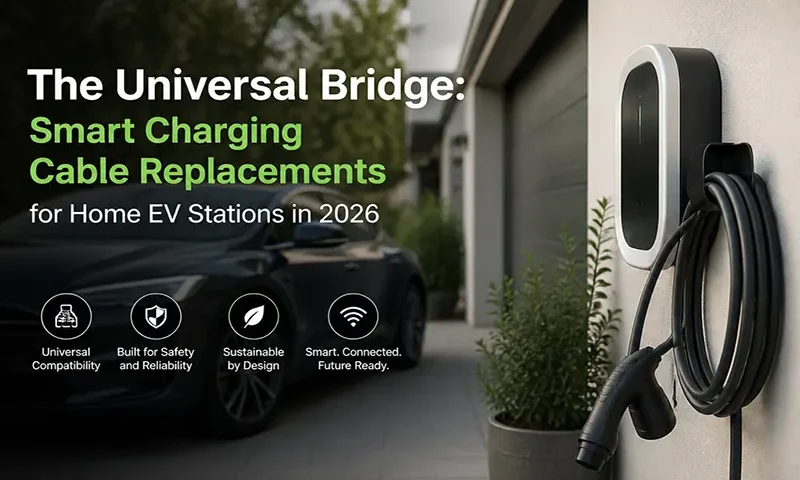
The home garage has transformed. No longer just a storage space for vehicles, it has become a sophisticated energy hub where the grid, the home, and the vehicle converge. As we move through 2026, the most critical piece of this infrastructure isn’t necessarily the wallbox itself, but the tether that connects it to the car.
The modern charging cable is no longer a “dumb” copper wire; it is a high-speed data link and a smart power regulator. With the industry-wide shift toward the North American Charging Standard (NACS), homeowners are facing a “Universal Dilemma”: how to manage a household that may have one legacy J1772 vehicle and one new NACS-native vehicle without cluttering the garage with multiple stations and tangled adapters.
1. The Shift to Universal Interoperability
By 2026, NACS has become the dominant port for new EVs in North America, but millions of perfectly functional J1772-equipped vehicles remain on the road. The solution has arrived in the form of “Swap-Tip” or Interchangeable Head cables.
These 2026 universal cables allow users to physically swap the connector head at the end of the cable—transitioning from NACS to J1772 in seconds—without the electrical resistance or bulk of a separate adapter. This modularity ensures that a single home charging station can serve a Tesla, a Ford, and a legacy Hyundai with equal efficiency.
2. Smart Features: Data-Driven Charging
The replacement cables of 2026 are defined by their intelligence. They are designed to meet the ISO 15118 standard, which enables “Plug & Charge” functionality for home use.
- Plug & Charge: When you plug in, the cable automatically authenticates the vehicle and communicates its State of Charge (SoC) and battery health to your home energy dashboard.
- Dynamic Load Balancing: Modern smart cables communicate directly with your Home Energy Management System (HEMS). If the cable detects that the home’s total power draw is nearing the breaker limit—perhaps because the electric dryer and AC both kicked in—it will automatically “Thermal Throttle” the car’s intake to prevent a blackout.
- V2H Readiness: Many premium replacement cables are now built for bidirectional power flow. This allows the cable to act as a two-way street, pulling power from the car to run the home during a utility peak or a grid failure.
3. Safety and Build Standards
Charging at 48A or 80A for eight hours straight creates significant thermal stress. High-quality 2026 cables are engineered to SAE J3400 standards and include safety features previously reserved for commercial fast chargers.
- Active Thermal Monitoring: The handle of a smart cable now contains multiple thermistors. If the plug temperature exceeds 180°F (82°C) due to a loose socket or debris, the cable will instantly signal the wallbox to reduce current or shut down, preventing port melting.
- Durability: Premium cables now utilize TPU (Thermoplastic Polyurethane) jackets rather than cheaper PVC. This makes the cable significantly more flexible in sub-zero winters and resistant to the UV degradation common in outdoor installations.
4. Economics: Replacement vs. Full Upgrade
For many homeowners, their existing 240V wallbox is still perfectly functional, but the cable may be frayed, the connector may be a legacy standard, or it may lack “smart” connectivity.
| Feature | Basic Replacement Cable | Smart Universal Cable (2026) |
| Connector Type | Single (J1772 or NACS) | Universal / Interchangeable |
| Communication | Basic PWM Pilot | ISO 15118 / Plug & Charge |
| Data Connectivity | None | Wi-Fi / Bluetooth / 5G |
| Safety | UL 2251 | UL 2251 + Active Thermal Shutoff |
| Max Current | Typically 32A | Up to 80A (Hardwired Support) |
Replacing just the cable (averaging $150 – $250) is a highly cost-effective way to “future-proof” a garage compared to the $800+ cost of purchasing and installing a completely new smart station.
5. Future-Proofing Your Garage: A Checklist
When selecting a replacement cable in 2026, ensure it meets these “Must-Have” criteria:
- Interchangeable Tips: Ensure it supports both NACS and J1772 to accommodate guest vehicles or future purchases.
- Ampacity Rating: Choose a cable rated for at least 48A even if your current car only draws 32A; future batteries will likely support faster home charging.
- App Integration: Look for cables that allow you to track energy costs and set charging schedules to take advantage of off-peak utility rates.
- Weatherproofing: If your station is outdoors, ensure an IP67 or higher rating for the handle and connection points.
The cable is no longer just an accessory; it is the most frequently upgraded and vital link in the EV ecosystem. By choosing a universal, smart-enabled replacement cable, homeowners can bridge the gap between legacy hardware and the high-tech, NACS-dominated future. The “Universal Bridge” ensures that no matter what EV you drive today or buy tomorrow, your home remains the most reliable and intelligent “filling station” you’ve ever owned.

