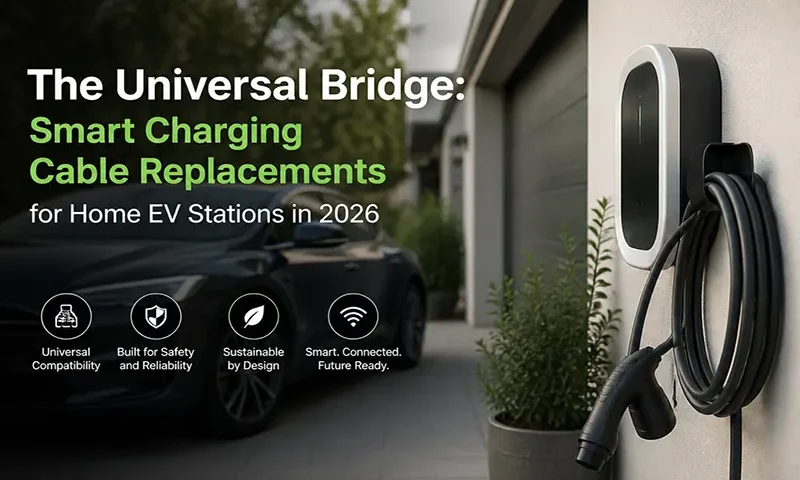
The Universal Bridge: Smart Charging Cable Replacements for Home EV Stations in 2026

The home garage has transformed. No longer just a storage space for vehicles, it has become a sophisticated energy hub where the grid, the home, and the vehicle converge. As we move through 2026, the most critical piece of this infrastructure isn’t necessarily the wallbox itself, but the tether that connects it to the car.

The modern charging cable is no longer a “dumb” copper wire; it is a high-speed data link and a smart power regulator. With the industry-wide shift toward the North American Charging Standard (NACS), homeowners are facing a “Universal Dilemma”: how to manage a household that may have one legacy J1772 vehicle and one new NACS-native vehicle without cluttering the garage with multiple stations and tangled adapters.

1. The Shift to Universal Interoperability

By 2026, NACS has become the dominant port for new EVs in North America, but millions of perfectly functional J1772-equipped vehicles remain … READ MORE ...

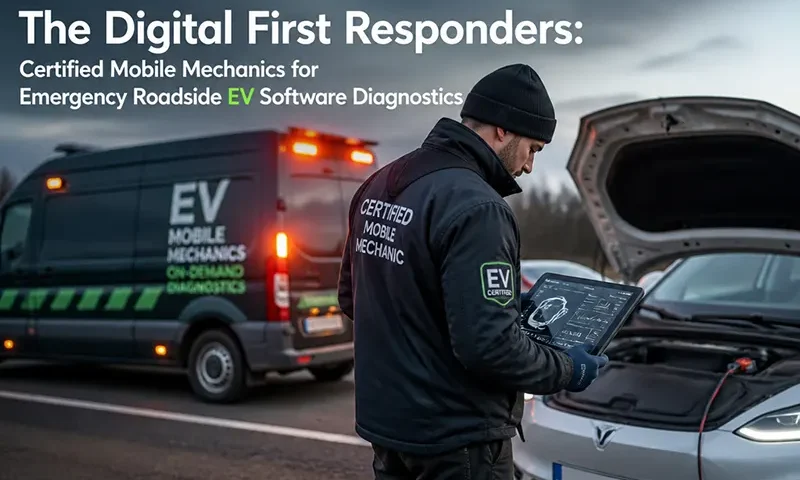
The Digital First Responders: Certified Mobile Mechanics for Emergency Roadside EV Software Diagnostics

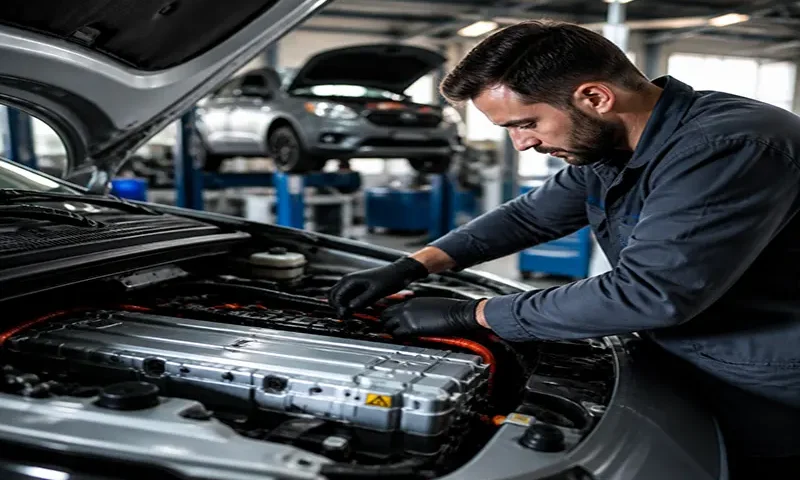
In the automotive landscape of 2026, the “breakdown” has been redefined. While internal combustion engines traditionally succumbed to mechanical failures—broken belts, fuel pump clogs, or radiator leaks—the modern Electric Vehicle (EV) is a sophisticated “computer on wheels.” Consequently, the most common reason for an EV becoming immobilized today isn’t a mechanical snap, but a software “handshake” failure or a logic loop in the Battery Management System (BMS).

The emergence of Certified Mobile EV Software Technicians marks a pivotal shift in roadside assistance. We are moving away from the era of the flatbed tow truck and toward the era of the “Digital First Responder”—highly skilled technicians who arrive in mobile cyber-labs to perform curbside triage on complex software-defined vehicles.

1. The Software-Defined Breakdown

For a 2026 EV, immobilization often occurs when the vehicle’s “brain” detects a conflict it cannot resolve. This might manifest as a vehicle that refuses to shift … READ MORE ...

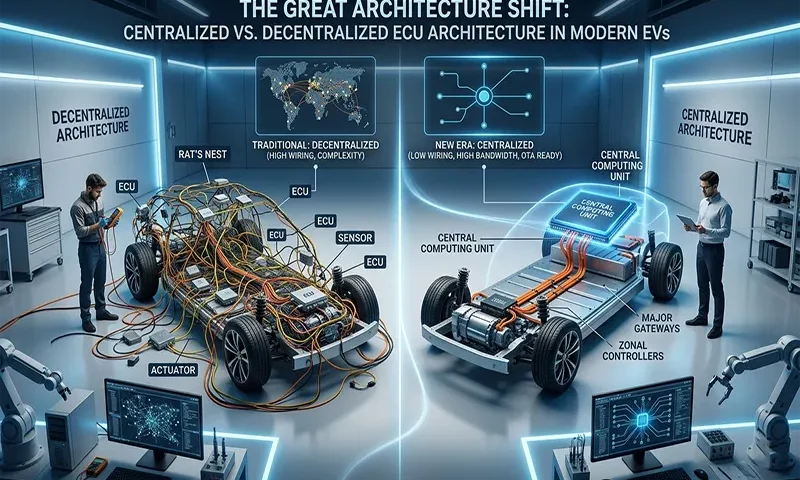
The Great Architecture Shift: Centralized vs. Decentralized ECU Architecture in Modern EVs

The automotive industry is currently navigating its most significant structural transformation since the invention of the assembly line. As we move through 2026, the focus has shifted from the mechanical “nuts and bolts” to the “bits and bytes.” At the heart of this revolution is a fundamental change in vehicle E/E (Electrical/Electronic) architecture. The transition from traditional, decentralized systems to centralized, zonal models is not just a technical preference; it is a survival requirement for the Software-Defined Vehicle (SDV) era.

1. The Complexity Crisis: The Wiring Harness Nightmare

For decades, the standard approach to vehicle electronics was “one function, one ECU.” If a manufacturer wanted to add power seats, they added a dedicated Electronic Control Unit (ECU) under the seat. By the early 2020s, premium vehicles reached a breaking point, carrying over 100 independent ECUs connected by miles of copper wiring.

This “Distributed Architecture” created a Wiring Harness Nightmare. … READ MORE ...

High-Performance Regenerative Braking Pads for Heavy Electric Vehicles

The transition to heavy-duty electric transport—encompassing Class 8 trucks, transit buses, and 8,000lb+ luxury SUVs—has introduced a fundamental “EV Brake Paradox.” In these vehicles, the electric motors perform the vast majority of deceleration via regenerative braking, converting kinetic energy back into the battery. Consequently, the physical friction brakes may sit dormant for miles. However, when those brakes are called upon—during a panic stop, a fully charged battery state (where “regen” is unavailable), or a system failure—they must arrest significantly more mass than their internal combustion engine (ICE) counterparts.

The kinetic energy equation,

$$E_k = \frac{1}{2}mv^2$$

, dictates that since a heavy EV often weighs 30–50% more than a comparable ICE vehicle, the friction hardware must be capable of absorbing and dissipating massive thermal spikes instantaneously, despite being “cold” just seconds prior.

1. Materials Science in 2026: Beyond Traditional Compounds

Historically, heavy-duty trucks relied on low-steel or semi-metallic pads for their … READ MORE ...

The 100-Mile Club: Best Plug-in Hybrid Cars with Extended Electric Range in 2026

For a decade, the Plug-in Hybrid Electric Vehicle (PHEV) was often viewed as a compromise—a “compliance car” with just enough battery to satisfy tax credits but not enough to change daily driving habits. In 2026, that narrative has officially shifted. We have entered the era of the Super Hybrid.

The 100-mile electric range is the new “tipping point.” At this threshold, a PHEV essentially functions as a full battery-electric vehicle (BEV) for the vast majority of weekly commutes, while retaining the “anywhere, anytime” flexibility of a gasoline engine for long-distance travel.

1. The Evolution of the ‘Super Hybrid’

In 2021, a “good” PHEV range was 30 miles. By 2026, breakthroughs in LMFP (Lithium Manganese Iron Phosphate) and high-density NMC (Nickel Manganese Cobalt) chemistries have allowed manufacturers to pack 25–40 kWh batteries into hybrid platforms without significantly encroaching on cabin or cargo space.

This evolution has transformed the PHEV from … READ MORE ...