
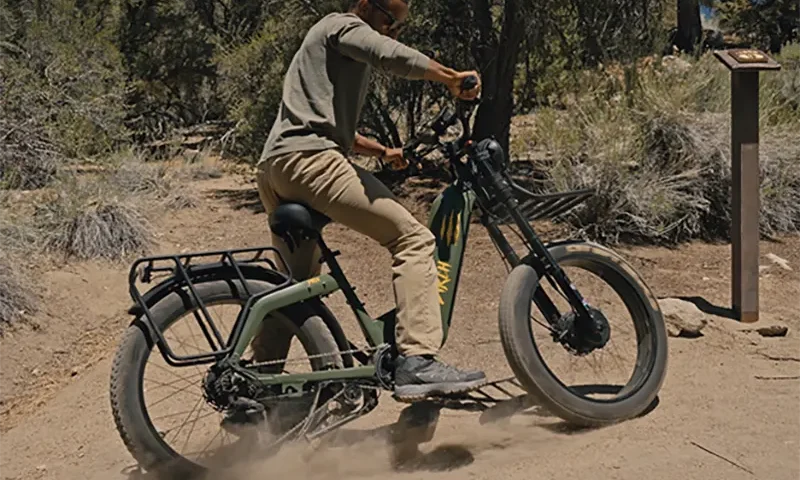
For the last few seasons, the debate in my hunting circle has been all about mid-drive vs. hub-drive electric bikes. I’ve always been a mid-drive purist. In the mountains, leveraging the bike’s actual gears to climb steep ridges just makes mechanical sense.
But this season, I kept hearing about the raw pulling power of All-Wheel Drive (AWD) hunting e-bikes like the Rambo Megatron and the Birch Grolar. Intrigued by the idea of dual-motor traction, I finally took an AWD beast deep into the backcountry to see if it was a legitimate tactical upgrade or just marketing hype.
After a week of navigating thick mud, hauling gear, and testing its limits, here is my honest field report.
1. First Impressions: A Truck on Two Wheels
The first thing you notice about an AWD hunting e-bike is the weight. Sporting dual motors (usually a 750W or 1000W hub motor in both the front and rear wheels), these bikes are heavy hitters, often tipping the scales between 90 to 110 lbs.
It feels less like a traditional mountain bike and much more like a stealthy, stripped-down mechanical pack mule. The frame is reinforced, the fat tires are massively wide (usually 4.8 inches), and the stance is wide and stable.
2. The Mud and Loose Terrain Test: Unstoppable Traction
This is where the AWD system completely blew me away.
Normally, when you ride a rear-wheel-drive bike through thick clay or loose sand, the rear tire digs a hole, loses momentum, and you end up stepping off into the muck. With the AWD engaged, the physics change entirely:
- The Pulling Effect: The front motor actively pulls the bike forward while the rear pushes.
- The Result: I rode straight through a saturated, swampy bottomland that would have completely bogged down my old mid-drive. Instead of fishtailing, the front tire clawed its way onto solid ground and pulled the rest of the bike right through.
Field Note: For flat, loose terrain, deep snow, or marshy lake edges, an AWD system is the undisputed king. It simply refuses to get stuck.
3. On-Demand Drive Modes: Managing the Battery
Dual motors mean dual power draw. If you run both motors at full blast all day, you will watch your battery percentage plummet faster than a dropped stone.
Thankfully, these rigs feature a handlebar toggle switch allowing you to select your drive mode:
- Rear-Wheel Drive (RWD): Perfect for conserving battery on the flat, hard-packed logging roads on the way into your zone.
- Front-Wheel Drive (FWD): Useful for specific steering assistance in slick scenarios.
- All-Wheel Drive (AWD): The “nuclear option.” I flipped this on only when approaching steep, muddy inclines or when crossing creek beds.
By managing the modes, I still managed to squeeze out about 38 miles of real-world backcountry range on a single charge—more than enough for a full day of scouting and stand placement.
4. Hauling Game: The Ultimate Test
The real test came on day four when we harvested a mature buck. We loaded the meat into a heavy-duty cargo trailer and hooked it up to the AWD’s integrated rear rack.
Towing an extra 150 lbs on a standard e-bike can make the front end feel incredibly light and twitchy, especially on a climb. But because the AWD bike has a motor in the front wheel, it kept the front end weighted and tracking straight. The linear, dual-wheel power delivery meant there was no “jerking” or chain-stretching strain—just steady, silent, unstoppable forward momentum back to the truck.
5. The AWD Hunting Compromise: Pros vs. Cons
Before you trade in your current rig, you need to understand the trade-offs:
| The Good | The Bad |
| Flawless Traction: Unmatched performance in mud, sand, and snow. | The Weight: At 100+ lbs, lifting this bike onto a truck bed or a standard hitch rack requires serious muscle. |
| Drivetrain Protection: Because power goes directly to the wheel hubs, you don’t risk snapping chains or stripping gears under heavy loads. | Steering Resistance: When front-wheel drive is engaged, you can feel a slight resistance in the handlebars when turning sharply. |
| Redundancy: If a rear motor component fails in the bush, you can literally drive yourself home using just the front motor. | Not for Vertical Mountains: On near-vertical, rocky single-tracks, a high-torque mid-drive still has the edge. |
The Final Verdict: Who is AWD For?
After a week in the field, I can confidently say that All-Wheel Drive is not a gimmick. If your hunting ground consists of steep, rocky, alpine single-tracks (think elk hunting in the Rockies), a premium mid-drive bike with full suspension remains your best choice.
However, if your hunting turf involves flooded timber, muddy farmlands, snowy northern woods, or coastal sand dunes, an AWD e-bike is an absolute game-changer. It provides a level of low-end grunt and stability that makes a traditional ATV look loud, clumsy, and entirely unnecessary.Have you ever experienced “rear-wheel spin-out” while trying to haul gear? I can help you look at the exact torque and motor specs of the top AWD hunting models to see if it’s the right fit for your local lease!

