
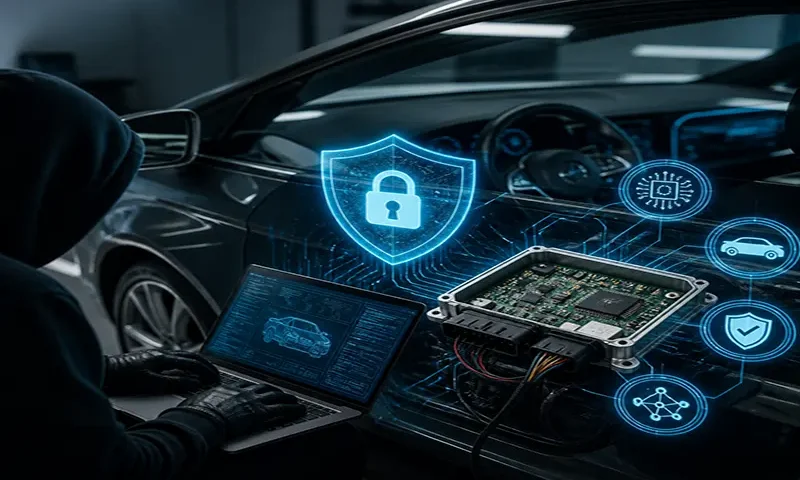
In 2026, the automotive industry exists in the “Overlap Era.” This is a transitional period where legacy CAN-bus systems—originally designed for isolated mechanical environments—must coexist with centralized, AI-driven Software-Defined Vehicle (SDV) architectures. As vehicles become increasingly connected to the grid, the cloud, and each other, the Electronic Control Unit (ECU) has become the primary battleground for cybersecurity.
Under the weight of global mandates like UN R155, cybersecurity is no longer a luxury feature; it is a prerequisite for market access and passenger safety.
1. Modern ECU Vulnerabilities in 2026
As the complexity of vehicle codebases has ballooned to over 200 million lines of code, the attack surface has expanded proportionally.
- Broken Authentication and UDS Exploits: Many ECUs still rely on weak “Seed and Key” implementations for Unified Diagnostic Services (UDS). Attackers who gain access to the OBD-II port or a wireless gateway can brute-force these keys to send unauthorized commands, such as reflashing firmware or bypassing immobilizers.
- The V2X and EV Charging Entry Path: The integration of Vehicle-to-Grid (V2G) technology has introduced a massive new vulnerability. Malicious code can now travel laterally from a compromised public charging station through the charging cable (ISO 15118) and into the vehicle’s powertrain ECU.
- Supply Chain “Invisible Code”: The 2026 supply chain is highly fragmented. The rise of AI-generated code snippets and the heavy use of third-party open-source libraries have led to “GlassWorm” vulnerabilities—hidden backdoors in the software stack that remain dormant until triggered by a specific cloud-based signal.
- OTA Infrastructure Hijacking: Because 2026 vehicles rely on Over-the-Air (OTA) updates for everything from seat heaters to braking logic, the Software Update Management System (SUMS) is a high-value target. A compromise at the OEM server level could theoretically allow an attacker to immobilize entire fleets simultaneously.
2. Critical Protection Standards & Regulations
To combat these threats, the industry has moved from voluntary guidelines to strict, enforceable standards.
- ISO/SAE 21434: This is the baseline for “Cybersecurity by Design.” It requires manufacturers to perform a Threat Analysis and Risk Assessment (TARA) at every stage of the vehicle’s lifecycle, from initial concept to decommissioning.
- UN Regulations R155 & R156: By mid-2026, these are the “gatekeeper” regulations. R155 mandates a Cyber Security Management System (CSMS), while R156 focuses on Software Update Management. Without certification against these standards, an OEM cannot obtain Type Approval to sell vehicles in major global markets.
- ASPICE for Cybersecurity: An extension of the Automotive Software Process Improvement and Capability dEtermination (ASPICE), this standard ensures that security isn’t just “added on” at the end but is baked into the quality of the development process itself.
3. Hardware & Software Defense Strategies
The 2026 defense-in-depth strategy relies on a “Zero-Trust” architecture within the vehicle network.
Hardware Trust Anchors
Modern ECUs now incorporate a Hardware Security Module (HSM). This is a physically isolated sub-processor that handles cryptographic keys, secure boot sequences, and message signing. By keeping keys in the HSM, even if the main ECU application is compromised, the attacker cannot “see” or steal the encryption keys.
Intrusion Detection and Prevention Systems (IDPS)
Unlike older systems that only looked for known “virus signatures,” 2026 IDPS solutions use machine learning to establish a “behavioral baseline” for the vehicle. If a window-lift ECU suddenly starts sending messages to the steering column, the IDPS recognizes this anomaly in real-time and kills the communication.
| Feature | Legacy Protection (Pre-2022) | 2026 Protection Standards |
| Communication | Plain-text CAN messages | SecOC (Secure Onboard Communication) |
| Authentication | Static passwords/pins | Dynamic PKI & Certificate-based Auth |
| Diagnostics | Open UDS access | Authenticated/Role-based Access |
| Security Logic | Perimeter-based (Firewalls) | Zero-Trust (Micro-segmentation) |
| Key Storage | Software-defined (Obfuscated) | Hardware Security Modules (HSM) |
4. Secure Communication Protocols
Internal vehicle traffic has shifted toward Automotive Ethernet for high-bandwidth tasks (like ADAS), which allows for the use of TLS (Transport Layer Security). For the more traditional CAN-bus segments, SecOC adds an authenticated “Message Authentication Code” (MAC) to every signal. This ensures that even if an attacker injects a “Brake” command onto the bus, the receiving ECU will ignore it because it lacks the valid, HSM-generated signature.
In 2026, automotive cybersecurity has matured from a niche engineering concern to a fundamental pillar of vehicle roadworthiness. As the industry moves toward fully autonomous systems, the integrity of the ECU is the only thing standing between a safe commute and a catastrophic system failure. For the modern automotive professional, understanding the intersection of ISO 21434 and Hardware Trust Anchors is no longer optional—it is the baseline for building the future of mobility.

