
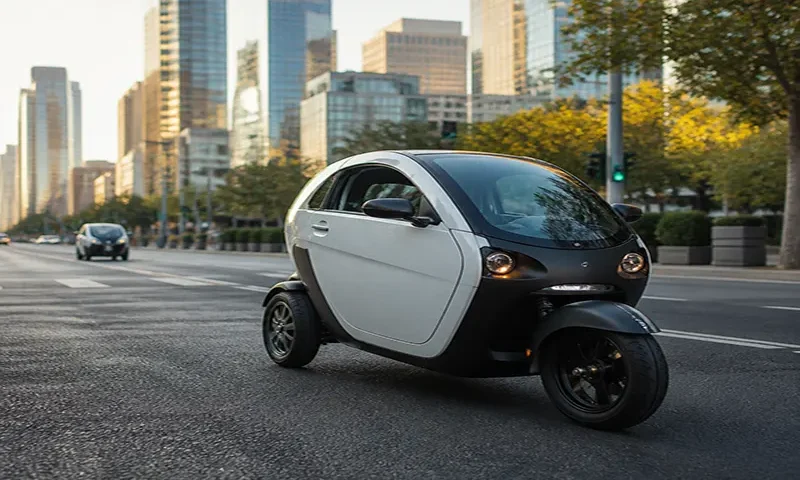
In the dense urban centers of 2026, the traditional four-door sedan has become a liability. As metropolitan areas worldwide enforce stricter congestion zones and “15-minute city” initiatives, a new category of vehicle has reclaimed the asphalt: the ultra-compact three-wheel electric car.
These vehicles, often classified as “autocycles,” address the fundamental geometry of urban congestion. With 76% of commuters still traveling alone in 2,000kg vehicles, the math of the modern city simply didn’t add up. Enter the 2026 three-wheeler—a marriage of motorcycle agility and automotive safety.
1. The Engineering of Efficiency: Less is More
The brilliance of the 2026 ultra-compact lies in its extreme weight-to-range ratio. By shedding the fourth wheel and the massive structural requirements of a 2-ton SUV, these vehicles redefine what a kilowatt-hour can achieve.
- Curb-Weight Optimization: Most 2026 models weigh between 500kg and 800kg. This allows for a 100+ mile range using a modest 10-20kWh battery, significantly reducing the environmental footprint of lithium mining.
- Active Tilt Control: Modern narrow-track vehicles like the Nimbus One utilize proprietary tilting technology. Sensors adjust the vehicle’s lean in real-time, allowing it to stay upright at stoplights while leaning into corners at speed with the stability of a tripod.
- The “Never Charge” Standard: 2026 has seen the production reality of integrated solar. Vehicles like the Aptera utilize over $3 m^2$ of solar cells embedded in the bodywork, harvesting up to 40 miles of free range per day simply by being parked in the sun.
2. Top Ultra-Compact Models of 2026
The Solar King: Aptera Motors
After years of anticipation, Aptera’s first validation vehicles rolled off the Carlsbad line in early 2026. With a drag coefficient ($C_d$) of just 0.13, it is the most aerodynamic vehicle on the road. It isn’t just a city car; it’s a highway-capable machine with up to a 1,000-mile range option, making it the flagship of the three-wheel movement.
The Lane-Splitter: Nimbus One
The Nimbus One is the ultimate solution for the “Concrete Jungle.” Occupying only 25% of a standard parking spot, it is designed to filter through traffic in cities where micro-mobility laws have been updated to allow “narrow-track” lane-splitting. It features a removable battery system, allowing apartment dwellers to swap power packs at home.
The Utility Specialist: Arcimoto FUV & Deliverator
The Oregon-based Arcimoto has dominated the “Fun Utility Vehicle” (FUV) and “Deliverator” markets. In 2026, the Deliverator has become a staple for last-mile delivery fleets, offering a 102-mile city range and a modular back that can be swapped for refrigerated or heated cargo units.
3. The Economics of 2026 Micro-Mobility
The shift toward three-wheelers is as much about the wallet as it is about the planet.
- Commuter Subscriptions: Many 2026 urbanites have moved away from ownership toward $99/month subscriptions that include insurance, maintenance, and dedicated micro-parking access.
- Parking ROI: In 2026, major commercial real estate developers have converted single SUV stalls into 4-for-1 micro-parking bays, offering discounted rates for ultra-compact vehicles.
- Registration Perks: Under 2026 regulations, most autocycles are registered as motorcycles (saving on taxes) but require only a standard Class C driver’s license to operate.
4. Safety and Tech Benchmarks
| Metric | Standard EV Sedan (2026) | Ultra-Compact 3-Wheeler (2026) |
| Weight | ~1,800 kg | ~600 kg |
| Efficiency | 4 miles / kWh | 10 – 12 miles / kWh |
| Parking Footprint | 8.5 $m^2$ | 2.1 $m^2$ |
| Safety Suite | Full ADAS / 8 Airbags | Roll Cage / Frontal Airbags / AI Collision Avoidance |
Despite their size, 2026 ultra-compacts are far from fragile. They feature high-strength steel roll cages and AI-driven Advanced Driver Assistance Systems (ADAS) that are optimized for the erratic movements of urban pedestrians and cyclists.
Reclaiming the Street
In 2026, the “big” car has become a city liability—difficult to park, expensive to charge, and slow in traffic. The ultra-compact three-wheeler represents a return to human-scale transit. These vehicles don’t just move people; they reclaim public space. By replacing a single idling SUV with four nimble, solar-powered autocycles, the city of 2026 is quieter, cleaner, and finally moving again.

