
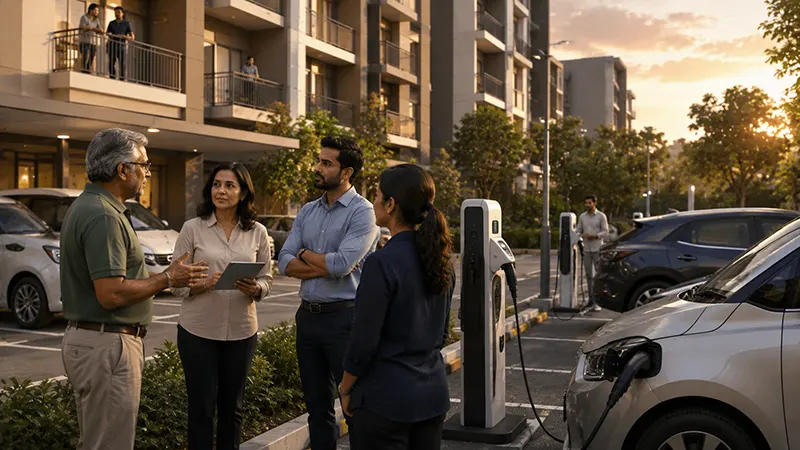
Every apartment community will eventually face the same question: How many EV chargers should we install?
The answer isn’t as simple as installing one EV charger for apartment parking or adding chargers for every parking slot. Effective EV charging for buildings depends on current EV ownership, future demand, available electrical capacity, and smart planning. Getting this balance right can help apartment communities avoid unnecessary costs while preparing for the future.
Start with Demand, Not Parking Spaces
A common misconception is that every parking bay needs a dedicated charger from day one.
In reality, EV adoption happens gradually. An apartment with 200 parking spaces may currently have only 10–15 EVs. Installing 200 chargers upfront would be expensive, underutilized, and difficult to justify.
Instead, communities should ask:
- How many EVs currently live in the building?
- How many residents plan to buy an EV in the next three to five years?
- How long are vehicles typically parked?
Since most apartment residents charge overnight, a single charger can often serve multiple vehicles over time if usage is managed effectively.
Factors That Determine Charger Requirements
Every residential community is different. The ideal number of chargers depends on several factors.
| Factor | Why It Matters |
| Number of existing EV owners | Determines immediate charging demand |
| Expected EV adoption | Helps future-proof infrastructure |
| Parking duration | Longer parking allows slower, shared charging |
| Available transformer capacity | Limits how many chargers can operate simultaneously |
| Electrical load management | Enables more chargers without major upgrades |
Rather than focusing only on today’s needs, RWAs should plan infrastructure that can expand as EV ownership increases.
Shared Charging vs Dedicated Chargers
Apartment communities generally choose between two approaches.
Dedicated Chargers
Each EV owner installs a personal charger in their allotted parking space.
Advantages
- Always available
- Convenient overnight charging
- Suitable for regular EV users
Considerations
- May require individual electrical connections
- Can become challenging to manage as adoption grows
Shared Chargers
Multiple residents use common charging stations managed through bookings or access control.
Advantages
- Lower upfront investment
- Better utilization
- Easier maintenance
Considerations
- Requires scheduling during peak demand
- May need charging management software
Many newer apartment projects adopt a combination of dedicated and shared charging to maximize flexibility.
Conclusion
There is no universal formula for deciding how many chargers an apartment needs. The right number depends on current demand, expected EV adoption, available electrical capacity, and how residents use their vehicles.
Rather than installing chargers for every parking space immediately, apartment communities should focus on scalable infrastructure that grows with demand. Forward-looking solutions from providers such as Bolt.Earth demonstrate how smart energy management and phased deployment can help residential societies build reliable charging infrastructure without unnecessary capital expenditure.
By treating EV charging as part of a long-term infrastructure strategy, not a one-time installation, RWAs and property managers can create future-ready communities that are prepared for India’s accelerating transition to electric mobility.

